This report is not a personal recommendation and does not take into account your personal circumstances or appetite for risk.
Share trading mistakes Page 1
Most people who invest in shares do so in solitude, believing themselves immune to the typical mistakes repeatedly made by the vast majority. To help you avoid these pitfalls we look at some of the most common and costly mistakes to avoid to help you extend your investing lifetime for as much profit and duration as possible.
1. Easy as 1, 2, 3
Many people think calling the direction of a share price is easy and so just jump in. No research, no plan, no objectives. This can be a risky way to start investing. While you may bank some quick profits, what happens if you are hit by a succession of losses? After all, you are risking your money. While you might be prepared to risk that cash, you don’t really want to lose it, do you?
2. Master plan
Consider asking yourself the following questions:
Why am I investing?
What returns am I looking to generate?
What kind of losses can I stomach?
How frequently do I think I’ll invest?
Over what time-frame?
Which product should I use?
These questions can all help you decide how you should invest, defining how much exposure to take on any one position at any one time in order for you to achieve your goals all the while respecting your investment parameters. Increased risk can deliver increased profits, but with it comes risk of increased losses. After all, you only get one chance to lose all your money. Lastly, if you have a plan, stick to it.
Essential to your investment success is having three key elements in place; the right strategy, the right information and research and most importantly the right product.
3. What kind of investor are you?
While most people understand traditional shares, this doesn’t mean they are the only way to speculate on a company’s share price moves. You may be pleasantly surprised that a host of alternatives could well be more appropriate for you depending on your chosen style of investing.
Look at the below profiles and see which fits your current approach and which might better fit your style and requirement.
Ordinary share platform – Buy and hold; long-term; low frequency; costs not important; stamp duty applicable; telephone dealing; possibly no online platform; delayed pricing
Contracts for Difference (CFDs) – Less capital intensive; medium to high frequency; low costs; stamp duty exempt; online platform; bigger deal sizes (if you so desire)
SpreadBetting (SB) – Small deal sizes; less capital intensive; high frequency; low costs; stamp duty exempt; tax benefits; online platform
4. Tying up too much
Buying physical shares obliges you to shell out the full value of the position upfront, even if you consider it unlikely the shares will ever fall to zero. Maybe you don’t even think they will fall by 25%. So why tie up 100% of your cash unnecessarily? Other products allow you to take the same level of exposure to your favourite shares while requiring significantly less to be paid up-front, potentially even saving you money along the way via lower transaction costs (i.e. no stamp duty).

5. The only way is up?
Most people aim to profit from rising prices. It’s a natural thing and fine so long as prices only rise. But we all know that they both rise and fall – to differing extents within differing trends over differing time horizons. This is what makes the markets interesting and presents us with investment opportunities.
With a traditional shares account limiting you to Buying and thus having only Long positions in your portfolio this means you are hostage to any price declines which could be a risky strategy if markets take a turn for the worst. While having share positions in 10 different companies can be considered diversification, expecting all 10 to rise is also probably a little optimistic. The same applies to putting all your eggs in one basket and all your money in one stock. Egos need to be put in a box.
Other products are available to allow you profit from both rises AND falls in share prices. Identifying and being able to speculate on share prices which may be set to fall could help you hedge/balance your existing portfolio, making it less prone to suffering big losses when the markets turn down.
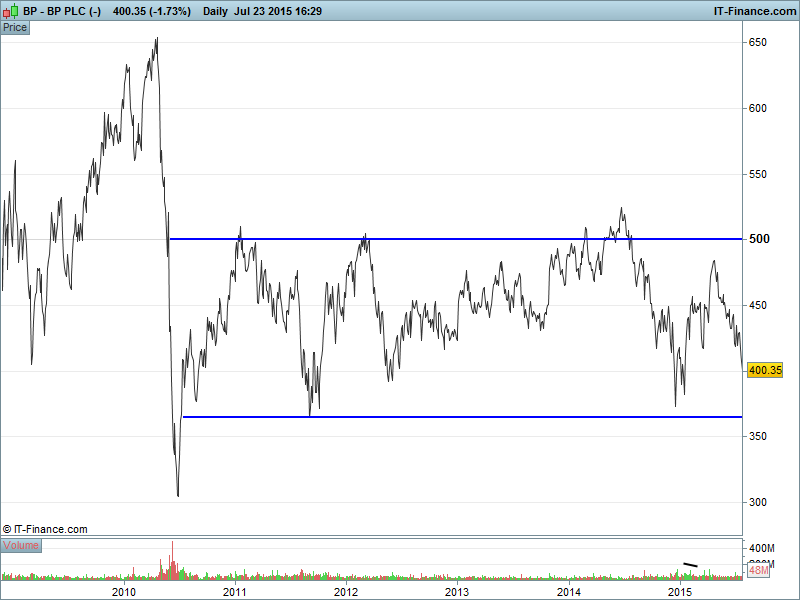
For example, had you bought BP shares in March 2009 (see chart below) and held them for 6 years, all the way through the tough Gulf of Mexico disaster period (May 2010; shares -54%), they might have delivered zero capital returns, your only profit coming from dividends (suspended for most of 2010) and having had to put up with a roller coaster of a ride. Note, however, the 365p and 500p levels which offered several buying and selling opportunities and potential returns of 30% each time for those prepared to trade the inevitable ups and downs that the shares have offered over the years.
Source: IT Finance
6. “It can’t fall that far!”
It’s natural to focus on what profits can be made. It’s optimism. It’s human nature. But it’s also important to consider what you could lose on that position before deciding whether it is worthwhile or not.
The best investors/traders always consider the worst-case scenario for each transaction too, i.e. – how far the price could move against them. While we tend to be quick to set exit levels for profits, it’s equally important to do the same at the other end to limit the possible damage from a bad trade.
“Only risk money you can afford to lose. You’ll be less emotional and more rational”
The experienced weigh up the potential risk AND reward involved in every trade before deciding whether to proceed. While there is nothing wrong with placing lots of trades with the aim of banking lots of small profits (it is a perfectly valid strategy) risking too much and taking too many costly losses along the way is best avoided. See our educational piece on Risk vs Reward for more details.
“Investing is as much about capital preservation as it is about capital accumulation”
What’s more, if a profitable position wants to become more profitable, why not let it? Trailing stop losses, allowing you to lock in rising profits, are one of several tools rarely available to traditional share investors who are lucky if they have access to even simple stop losses usually having to open/close all positions manually.
« Back to Category
This research is produced by Accendo Markets Limited.
Research produced and disseminated by Accendo Markets is classified as non-independent research,
and is therefore a marketing communication. This investment research has not been prepared in accordance
with legal requirements designed to promote its independence and it is not subject to the prohibition on
dealing ahead of the dissemination of investment research. This research does not constitute a personal
recommendation or offer to enter into a transaction or an investment, and is produced and distributed for information purposes only.
Accendo Markets considers opinions and information contained within the research to be valid when published,
and gives no warranty as to the investments referred to in this material. The income from the investments referred to may go down as well as up,
and investors may realise losses on investments. The past performance of a particular investment is not necessarily a guide to its future performance.
Prepared by Michael van Dulken, Head of Research