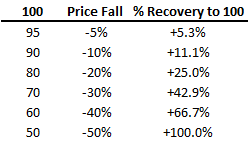
Doubling down: a 50% fall requires a 100% recovery to break even!


This report is not a personal recommendation and does not take into account your personal circumstances or appetite for risk.
Doubling down: a 50% fall requires a 100% recovery to break even!
With information and analysis everywhere we turn, and updated almost instantly, there are millions of reasons to trade, all day every day. Remember though that it is your money at risk and you have a choice. There is no obligation to trade every idea that comes your way.
There will be plenty more opportunities tomorrow. Just as risk increases with bigger trade sizes, so it does with more frequent trading, which is fine so long as it doesn’t take you too far from the parameters of your trading plan. If so, does you plan need updating? The best traders won’t place trades just for the sake of it.
Keeping a record of your trades and reviewing things regularly is a helpful exercise. For a portfolio of open trades, where did you get each idea? Pros? Cons? Duration? Target? Stop loss? Some even say that when reviewing a portfolio of open trades each day, if you can’t see a valid reason for entering one of them today then why should you still be in it from yesterday?
For closed trades did you stick to your plan? Did it work? Did you stay within your parameters? What did you learn? What would you do different next time? Be honest with yourself. You only have yourself to answer to.

A key CFD attraction can also be what generates the most expensive trading mistakes. While CFDs allow you place trades with only a small deposit this doesn’t oblige you to leverage up to the max.
First of all, the deposit is just that, what you need to open the position. The trade still needs room to breathe as the price moves around. Funds or margin are thus required to allow the trade go against you at least slightly. The more positions you have open, the more margin is required. The more you want to allow positions go against you, the more margin is needed to avoid ‘margin call(s)’. Remember what we said about focusing on only the potential profits and forgetting about the potential losses?
Overleverage can be avoided by considering your overall exposure (all exposure on all open trades) and overall margin requirements as well as using stop losses to reduce potential losses (and thus margin requirement) on individual trades. If you believe that the price can fall by X and you can afford to lose Y, then that information can be used to decide an appropriate size for your trade.
If your account is worth £10,000 and you are prepared to lose £1,000 should the current 250p share price fall by 10% (25p), then your trade size should be set up accordingly with the 25p share price fall equating to £1,000 which in turn equates to 400 shares and £10,000 exposure.
Indices
When trading the indices, £10,000 on a CFD account could allow for exposure to 10 UK 100 contracts at £10 per point. With the UK 100 index at 6800 this would mean exposure of £10 x 10 x 6800 = £680,000. Yes that’s correct, more than 2/3 of a million pounds. If the index fell by just 1.5%, however, which is quite possible, your £10,000 account could be wiped out and you left owing an additional £200. You over leveraged yourself.
This research is produced by Accendo Markets Limited. Research produced and disseminated by Accendo Markets is classified as non-independent research, and is therefore a marketing communication. This investment research has not been prepared in accordance with legal requirements designed to promote its independence and it is not subject to the prohibition on dealing ahead of the dissemination of investment research. This research does not constitute a personal recommendation or offer to enter into a transaction or an investment, and is produced and distributed for information purposes only.
Accendo Markets considers opinions and information contained within the research to be valid when published, and gives no warranty as to the investments referred to in this material. The income from the investments referred to may go down as well as up, and investors may realise losses on investments. The past performance of a particular investment is not necessarily a guide to its future performance. Prepared by Michael van Dulken, Head of Research
Comments are closed.