Volume – What’s going on behind the Scenes?


This report is not a personal recommendation and does not take into account your personal circumstances or appetite for risk.
Click on the image to enlarge
Source: IT Finance
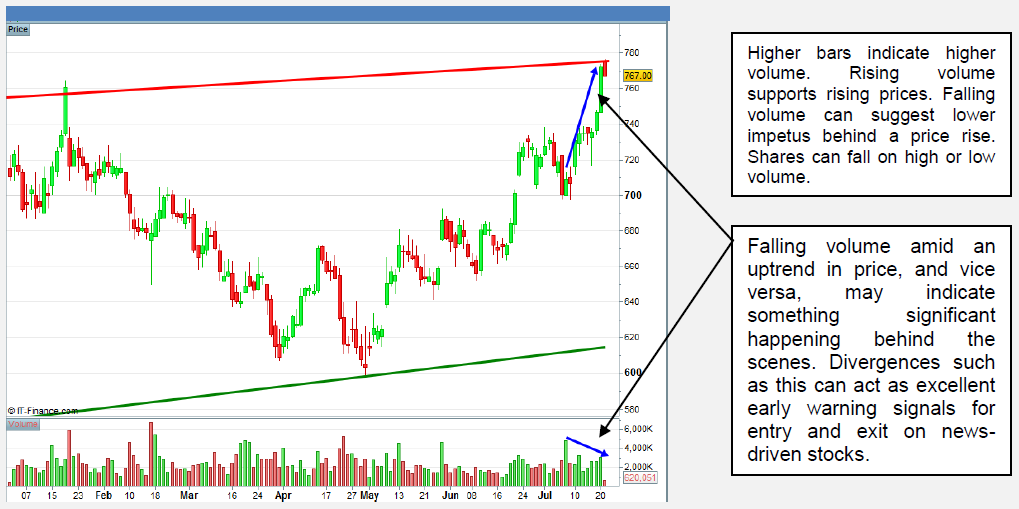
Looking at the vertical volume bars below the above price chart, you could identify when the volume of shares traded rises and falls. Given that it is assumed shares require volume (or market appetite) to rise, you can use increased volume to confirm that a rising price trend is valid. You could also use falling volume (as is the case above) to question a rising price trend such as the continued uptrend through July. Such a divergence, combined with the fact that shares have reached the trendline of resistance, could indicate an imminent correction or reversal.

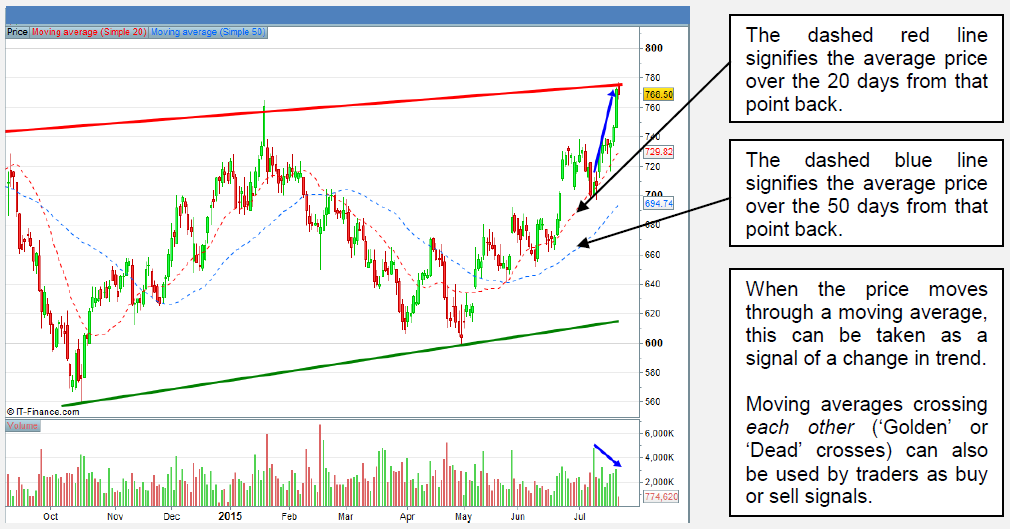
The dashed lines on the chart below are called the moving averages of the price. These take an average of the closing prices over a certain period. In our case we have used 20 days (red dashed line) and 50 days (blue dashed line), but there is no right or wrong choice here. Day traders will often use charts with time periods in the region of hours or even minutes, tailoring their choices to the specific security they are trading.
Click on the image to enlarge
Source: IT Finance
This research is produced by Accendo Markets Limited. Research produced and disseminated by Accendo Markets is classified as non-independent research, and is therefore a marketing communication. This investment research has not been prepared in accordance with legal requirements designed to promote its independence and it is not subject to the prohibition on dealing ahead of the dissemination of investment research. This research does not constitute a personal recommendation or offer to enter into a transaction or an investment, and is produced and distributed for information purposes only.
Accendo Markets considers opinions and information contained within the research to be valid when published, and gives no warranty as to the investments referred to in this material. The income from the investments referred to may go down as well as up, and investors may realise losses on investments. The past performance of a particular investment is not necessarily a guide to its future performance. Prepared by Michael van Dulken, Head of Research
Comments are closed.