Markets Overview:
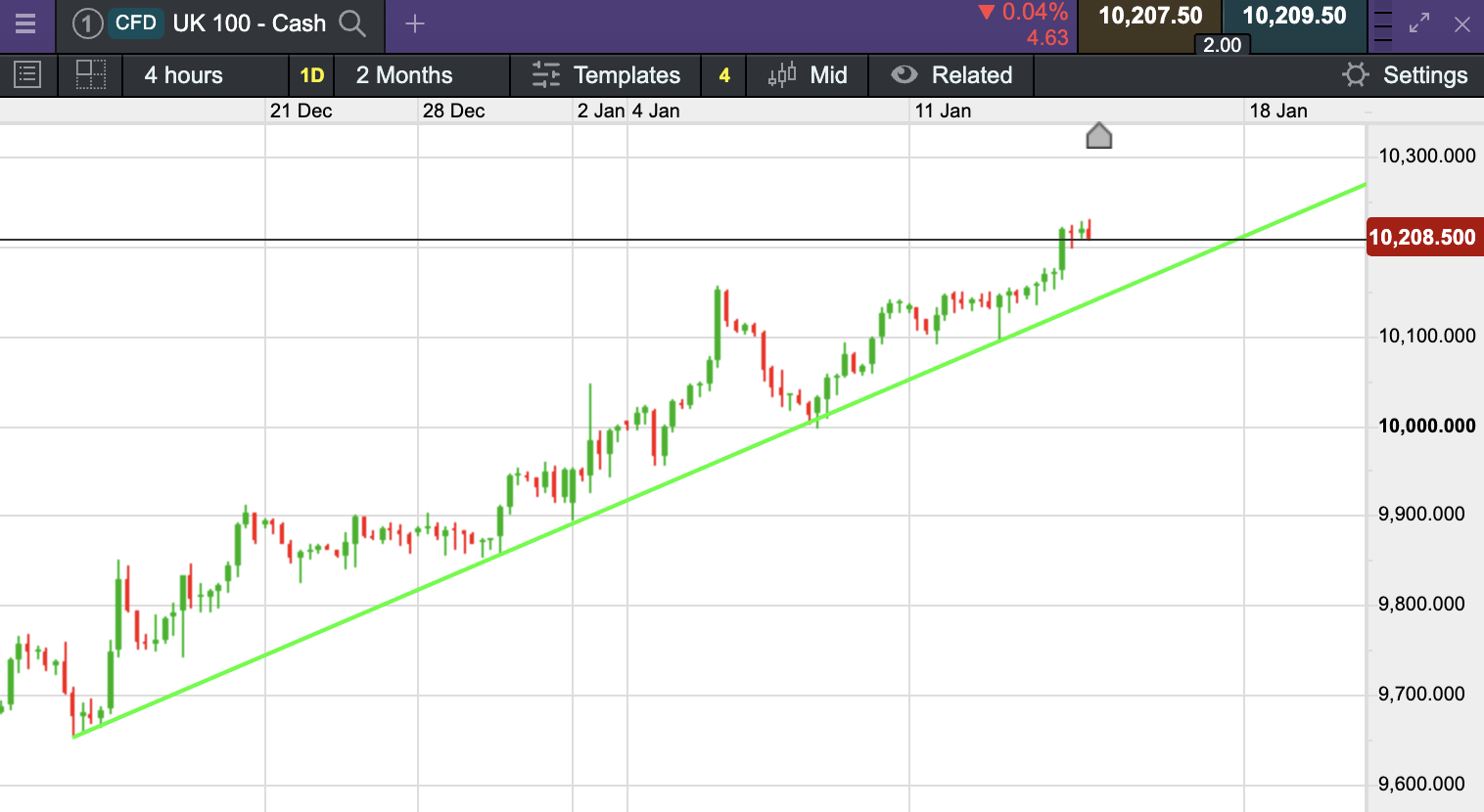
The UK 100 is called to open +24 points at 10,208. The UK 100 this comes after the UK’s blue-chip index closed at a record high on Wednesday, up 0.46% at 10,184, while the UK 250 rose 0.1%. Miners led the gains as copper hit fresh highs, with Rio Tinto up 2.3% and Glencore up 3%. Healthcare also outperformed, helped by AstraZeneca, which rose about 2.4% after agreeing to buy Modella AI. Media stocks lagged, dragged down by a 9.5% fall in Pearson after it lost a contract in New Jersey. Housebuilders were weak, with Vistry down 8.8% after flagging softer forward sales.
The UK economy grew by a better-than-expected 0.3% in the Budget month of November, the Office for National Statistics said today. The improvement following a decline of 0.1% in October compared with City forecasts for a figure of 0.1%. Services and production both grew in November by 0.3% and 1.1% respectively but . construction fell by 1.3%. The ONS said the economy grew by 0.1% across the three months to November. ONS director of economic statistics, Liz McKeown added: “The economy grew slightly in the latest three months, led by growth in the services sector, which performed better in November following a weak October.
U.S. equities ended lower on Wednesday as the rotation away from mega-cap technology and large banks continued. The S&P fell about 0.5%, the Nasdaq dropped roughly 1%, while the Dow finished slightly lower. All of the “Magnificent 7” stocks closed down and the Mag 7 ETF fell 1.5%, weighing on the tech-heavy indexes. Consumer discretionary, technology and communication services were the weakest sectors. Banks extended recent losses, with the S&P 500 banking index down 2%. Wells Fargo fell sharply after missing fourth-quarter profit expectations, while investors also reacted cautiously to results from other major lenders. Earlier in the week, JPMorgan beat profit estimates but warned that a proposed cap on credit card interest rates could hurt consumers and the economy, weighing on the broader financial sector. Bank of America, Citigroup and Wells Fargo reported mixed trends in trading, consumer credit and net interest income, reinforcing concerns that margins are under pressure even as loan growth remains stable. In contrast, regional banks and small caps outperformed, with the Russell 2000 rising again to another record close and the S&P 500 equal-weight index also setting a new high. Energy was among the few gainers, and value stocks outperformed growth. Data showed U.S. producer prices broadly in line with forecasts and retail sales stronger than expected, reinforcing the view that the economy remains resilient and the Fed is likely to stay on hold in the near term.
Asian markets were mixed as the global rotation out of technology continued. In Japan, the Nikkei fell about 0.9% after hitting a record the previous day, while the broader Topix rose 0.4% to another high. Taiwanese and Hong Kong stocks slipped, weighed down by tech. Mainland Chinese blue chips were flat after Beijing tightened margin financing rules earlier in the week. South Korea’s KOSPI rose to a fresh record after the central bank left rates unchanged and signalled the end of its easing cycle. Taiwan Semiconductor reported a strong set of results, posting a 35% jump in fourth-quarter net profit to a record T$505.7 billion, comfortably beating market forecasts. The world’s largest contract chipmaker benefited from surging demand for advanced semiconductors used in artificial intelligence, with customers including Nvidia and Apple driving volumes. The results reinforced the strength of the AI investment cycle and provided a supportive backdrop for the global semiconductor sector. Investors remain focused on Japan’s political outlook, with Prime Minister Sanae Takaichi expected to dissolve parliament’s lower house and call a snap election as early as February 8 — a move that has driven stocks higher but pressured the yen and bonds.
Company News & Broker Comments:
Company News:
Ashmore Group on Thursday reported assets under management (AUM) of $52.5 billion as of December 31, exceeding analyst expectations of $49.9 billion. The asset manager posted net new money (NNM) of $2.6 billion in the second quarter of fiscal 2026, significantly above consensus estimates of $0.1 billion. This marks the first positive net inflows since June 2021, following outflows of $0.3 billion in the previous quarter. The company saw inflows across both fixed income and equities, with increased allocations to external debt and local-currency strategies. New institutional mandates also contributed to the growth in equities and blended debt segments. Breaking down the AUM by category, External Debt reached $8.4 billion (versus consensus of $7.3 billion), Local Currency hit $15.7 billion (consensus $14.6 billion), and Corporate Debt stood at $5.3 billion (consensus $5.5 billion). Blended Debt totaled $12.5 billion (consensus $12.4 billion), while Equities reached $8.8 billion (consensus $8.2 billion) and Alternatives remained at $1.8 billion, in line with expectations. Ashmore’s fund performance outpaced benchmarks by 0.5% on a one-year basis and 1.3% on a three-year basis.
Dunelm Group reported a solid first half in a difficult UK retail environment, with total sales rising 3.6% year-on-year to £926m and digital sales increasing to 41% of the mix. While strong trading in the first quarter was followed by a softer second quarter—particularly around Black Friday and into December amid intense discounting and marketing competition—core categories such as bedding, towels, lighting and Made-to-Measure performed well, offsetting weaker furniture sales linked to availability issues. Gross margin improved by 60 basis points, helped mainly by foreign exchange tailwinds, and first-half profit before tax is expected at £112m–£114m, with full-year profit now guided to the lower end of market expectations. Management is pushing ahead with strategic initiatives to reinforce Dunelm’s market position, including new and reopened stores, the rollout of a new mobile app and targeted actions to improve product availability, as it seeks to capitalise on opportunities to extend its leadership in homewares despite ongoing macroeconomic pressures.
Taylor Wimpey today reported a lower order book and warned that its profit margin is set to contract for another year. The former UK 100 company said demand remains muted, particularly among first time buyers. It ended last year with an order book worth £1,86 billion, which excluding joint ventures represents 6832 homes. This compares with figures of £2 billion and 7312 at the end of 2024. Revenues for last year increased to £3.8 billion from £3.4 billion in 2024, driven by higher volumes, average selling prices and land sales. It expects to deliver an operating profit of about £420 million, up from £416.2 million in 2024, on an operating profit margin of about 11% compared with 2024’s 12.2%. Overall pricing in the order book is currently around 0.5% lower year-on-year, while the company is experiencing low single digit build cost inflation. It added: “Taking these factors into account, we expect group operating profit margin to be lower in 2026 than in 2025 and, given the lower opening order book, for performance to be more second half weighted in 2026 than in prior years.” Chief executive Jennie Daly welcomed recent planning reforms as she said the company had seen increased momentum in its recent planning permissions. She added: “However, while affordability is slowly improving, demand continues to be muted – particularly among the important first time buyer category – which will constrain overall sector output. “Against this backdrop, we remain focused on unlocking value and maximising shareholder returns in the medium term.”
Reporting Today:
UK
Safestore Holdings (SAFE)
Dunelm Group (DNLM) – Trading Update
Ashmore Group (ASHM) – AUM Statement
Taylor Wimpey (TW.) – Trading Update
US
BlackRock Inc (NYSE:BLK) PMO
The Goldman Sachs Group Inc (NYSE:GS) PMO
Morgan Stanley (NYSE:MS) PMO
Taiwan Semiconductor Manufacturing Co Ltd ADR (NYSE:TSM) PMO
Reporting Tomorrow:
UK
None
US
None
In Focus Today:
Chinese Industrial Production
Chinese Retail Sales
UK Gross Domestic Product
UK Industrial Production
UK Manufacturing Production
EU Industrial Production
US Initial Jobless Claims
US Fed’s Bostic speech
Today & Tomorrow’s Ex-Dividends:
UK 100 companies going ex-dividend on 15th January 2026:
Diploma
Compass
UK 100 companies going ex-dividend on 16th January 2026:
Next
UK 250 companies going ex-dividend on 15th January 2026:
Grainger
Foresight Group Holdings
Future
AJ Bell
For any help you may require placing trades or in terms of market information, put a call in to our trading floor – it’s all part of the service.